
TRIAL AND EXECUTION OF LOUIS XIV
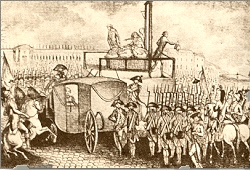
"On January 20, 1793, the National Convention condemned Louis XVI
to death, his execution scheduled for the next day. Louis spent that
evening saying goodbye to his wife and children. The following day
dawned cold and wet.Louis arose at five. At eight o'clock a guard
of 1,200 horsemen arrived to escort the former king on a two-hour
carriage ride to his place of execution ......
In December 11, 1792 King Louis XVI was brought to trial in front of the
National Convention,
which acted as the jury. The King was charged with conspiring against the
nation. His attorney was
his former minister of affairs and a philosopher, Malsherbes. But with
the convincing arguments of the
Girondins, Jacobins and the Montagnards, and the unveiling of Louis's secret
safe ,which held his
secret papers about bribing the city officals, the people's case was more
then rock solid. With all of
this evidence against him, the convention agreed that Louis XVI, King of
France, was guilty of
conspiring against the people of France and sentenced him to death by guillotine
on January 21,1793.
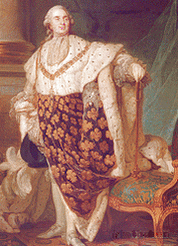 Louis XIV
Louis XVI's morning started off when Santerre of the National Guard and
two representatives
from the Commune showed up at 8:00 a.m. to the Place de la Revolution.
He rode in a coach through
the heavily guarded streets. The Commune hired thousands of armed men to
make sure that no one
tried to free the king. He arrived to the place of execution at ten in
the morning. With his hands tied
behind his back, he went up the stairs of the scaffold holding the guillotine,
and he got up there and
started speaking: "I die innocent. I pardon my enemies and I hope that
my blood will be useful to the
French, that it will appease God's anger...." His words were cut off by
the roll of drums. Then
Charles Sanson, the executioner, strapped him down and pulled the rope.
Louis' head head fell off
into a basket. Sanson's son picked up the head to the shouts coming from
the crowd of "Vive la
Nation!" The execution was over, and afterwards the people tried to dip
their handkerchiefs in the
blood of the deceased King.
After the execution of King Louis XVI, the French nation continued to struggle.
In January,
1793 the revolutionary government declared war on Britain, a war for world
dominion which would
continue for another twenty years. Meanwhile a counterrevolution in France
erupted, and the Paris
Commune continued to pressure the new government for more radical change.
The French Revolution
was not over.
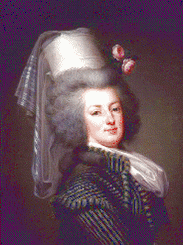 Marie Antoinette married Louis in 1770
when she was 14.She was executed at the guillotine on October 16, 1793
_________________________________________________________ Guillotine: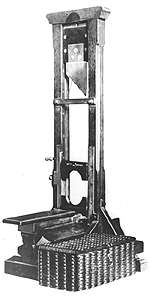

.gif)

List of events
Main page of French Revolution
Flood of my Blood
.