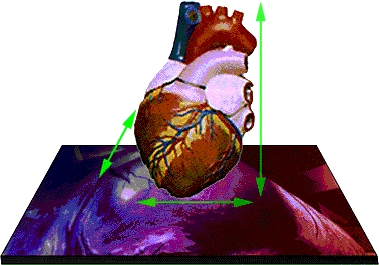

A human being's heart is about
the size of that human being's fist. As the body develops, the heart grows
at the same rate as the fist. So an infant's heart and fist are about the
same size at birth. In the womb, however, that similarity was not always
true. During the first few weeks after conception, the fetal heart occupies
most of the fetus' mid-section. The heartsize to bodysize ratio is nine
times greater in the fetus than in the infant. During those first few weeks,
the fetal heart lies high in the chest. Soon, it moves down to occupy its
position in the chest cavity.
There are several phases of the fetal heart's development. At first, the
heart is just a tube. It grows so fast that it needs more space, so it
bends and twists back, forming the familiar shape. During the next phase,
the two atria are partly separate but there is just one big ventricle.
The next phase begins when the two atria are completely separate and the
ventricles are just beginning to separate. Finally, the ventricles separate
completely and the heart is developed.
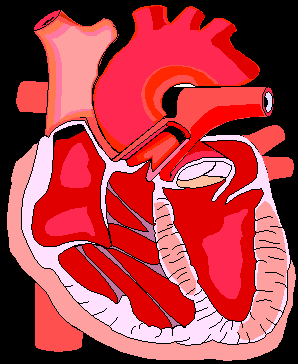 During the fetal heart's developmental stages, the heart actually takes
on several distinct appearances. These heart structures resemble other
animal hearts. During phase one, the tube-like heart is much like a fish
heart. The second phase, with two chambers, resembles a frog heart. The
three-chambered phase is similar to a snake or turtle heart. The final
four-chambered heart structure distinguishes the human heart.
During the fetal heart's developmental stages, the heart actually takes
on several distinct appearances. These heart structures resemble other
animal hearts. During phase one, the tube-like heart is much like a fish
heart. The second phase, with two chambers, resembles a frog heart. The
three-chambered phase is similar to a snake or turtle heart. The final
four-chambered heart structure distinguishes the human heart.
The heart, like other body parts, needs oxygen in order to grow and develop
properly. During childhood, the body's years of rapid growth, the need
for oxygen is greatest. The heart's rate of pumping oxygen-rich blood is
fastest in infancy, about 120 beats per minute. As the child grows, the
heart rate slows. A seven year old child's heart beats about 90 times per
minute. By the age of 18, the heart rate has stabilized to about 70 beats
per minute.
By adulthood, the heart is fully developed. Throughout life, the heart
needs only to be maintained and kept healthy in order to function. If you
take care of your heart, by following a prescription for a healthy heart,
your heart should take care of you for the rest of your life.
 Now
, it's time for us to know how to have a healthy heart ~
Now
, it's time for us to know how to have a healthy heart ~
you may backt to the front page of the heart 
 get back to the front page ofFlood
of my blood
get back to the front page ofFlood
of my blood