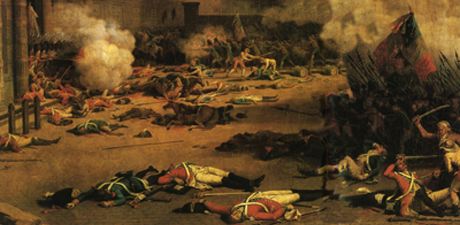



On August 10,1792 around 10 AM, a mob of perhaps 30,000 people advanced toward the Tuileries Palace to capture Louis XVI. Louis had been given information that told him that an angry mob was headed for the palace. He decided to move himself and his family to the Legislative Assembly building for he had been told they could not defend him in the palace.
Before the King fled with his 300 volunteers of the order of the Chevaliers de St. Louis,who were to protect him, he had left no orders for the Swiss Guard who defended the Tuileries. The guards saw the crowd coming and counted upon an order from Louis to surrender the palace as he had in an earlier attack, but the order never came. When the mob approached the palace, the guards scampered to the top walls to try and fight off the swarm with single-shot muskets. After firing a few rounds into the crowd and seeing what little damage they did, they surrendered the palace to save their lives. The mob searched the palace with blood in their eyes, and only 300 of the 900 Swiss Guards were left alive. But the people found no King. The soldiers' corpses laid mutilated. All servants, cooks, kitchen boys, door attendants, maids, women and children, and all people involved with the King were slaughtered. The people began throwing the dead bodies into piles. One eye witness reported seeing "some very young boys playing with human heads."1
By January of 1792, before the storming of the Palace, all sections of Paris, forty-eight of them, had built up a strong leadership; they could call an army up to fight at any given moment. These sections, also known as wards, could join together with the Cordelier's Club and give the people an organized plan of action in case of an emergency. In April of 1792 King Louis met with the Legislative Assembly about going to war with Austria and Prussia. Austria and Prussia had joined forces and decided to stop the revolution in France by taking it over and destroying its backers.They didn't want their subjects to get the idea of revolting. So the Legislative Assembly and King Louis decided to fight back against Prussia and Austria.
On June 20, 1792, also the third anniversary of the Tennis Court Oath, a group of 15000 people made their way toward the Tuileries Palace. This was the first attack on the Tuileries Palace. They first marched to the Legislative Assembly and then marched to the palace. A small group of the crowd was able to push passed the Swiss Guards and enter the palace. King Louis met them for he had been warned they were coming, and he offered the small crowd wine and began conversing with them in hopes of calming them down. Luckily the crowd finally left without harming anyone in the palace.
By late July the people of Paris began to panic because Austrian and Prussian troops were moving toward the city. By this time France had a reduced supply of experienced military officers, for most of them were noblemen who had emigrated or been demoted from any kind of political or military status during the Revolution. In their panic the people began to believe that Louis had communicated with the enemy and thereby committed treason. In the summer of 1791 Louis had tried to flee the country, and that action made people believe Louis had committed treason. So the leaders of the Paris Commune met on August 9 and decided to attack the palace on the next day. The word spread overnight to the 30000 people that attacked on August 10, 1792.
Once the brutality was over, the people hoped the King had been found so they could have their way with him. When Louis fled to the Legislative Assembly, he was hoping the Assembly would protect him, but the people found him and convinced the Assembly to release him. His arrest along with the arrest of his family set the stage for the end of monarchy in France and the trial of Louis himself.
List of events:  Main page of French Revolution
 .gif) Flood of my Blood
Flood of my Blood 